December 2025 Adaptations
Meet Martyn...
Martyn describes the devastating impact of his wife Anna’s MND diagnosis in 2023 aged 39. Now fully wheelchair-bound, Anna requires a power chair and major home adaptations that were partly funded by a Disabled Facilities Grant. Despite the emotional and financial strain, the family work hard to stay positive, using laughter to bring light to the darkness. Martyn prioritises Anna’s independence, family normality and campaigns for better support for MND families.
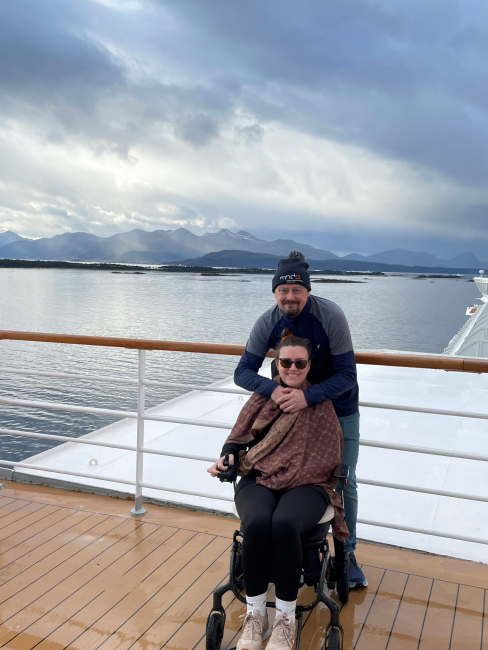
Martyn first shared his story with us in April 2024. We caught up with him again in November 2025.
Life before MND
"Everything with Anna and I has always revolved around family."
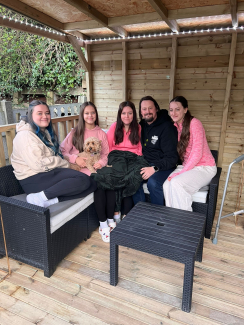
Me and Anna met when we were 16 or 17. I asked her out on a date, and I've never looked back. We were very young when we had our kids, got married and bought a house so family is my main priority. We've got three daughters and they keep me very busy. Everything with Anna and I has always revolved around family. After the girls were born Anna spent a bit of time reevaluating what she wanted to do. She moved into health and social care by working in care homes and then started working for Trafford Borough Council for over 10 years as a social worker and team leader. She loved her job, absolutely loved it. We've always worked hard. My career was working within telecommunications for a big telecommunications provider, then at the start of 2023 I decided I wanted to change and went to work with a charity for visually impaired people in the children's department which was absolutely amazing. Prior to MND, we both had really good social lives.
Early symptoms and diagnosis
"We're always open and honest with the girls, so we told them straight away."
We went through lockdown, and we always say as a family, we loved it. We were all at home together and in the garden. We love each other's company. It was over a period of time Anna's symptoms started. Going into the start of 2023 Anna was referred to neurology for some tests as urgent. They came back and said it wasn't urgent and put her on a 70-week waiting list. So, we just went on with life and then Anna was working one day at home and she had a panic attack. We went to the hospital, and it was only because the nurse said Anna had a bit of slurred speech, they decided they wanted to do some tests. They kept her in for two weeks and did multiple tests, and it was the last test, the EMG that confirmed it. They called us into a meeting and told us Anna was diagnosed with MND. We got told, we cried for about an hour. First thing that came to mind was the girls. We're always open and honest with the girls, so we told them straight away. We said that we wanted to rip the plaster off. We're a very positive family. That's how we've always done things, but that was one of the worst days of our lives.
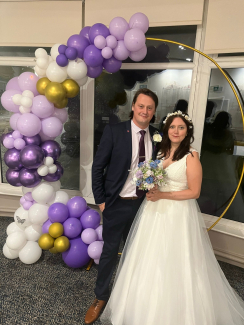
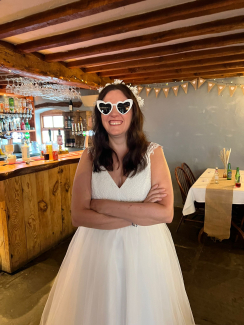
Anna and I got married in 2006 and we decided to renew our wedding vows in October 2023. One of Anna's stipulations was she wanted to walk down the aisle, so we wanted to do that sooner rather than later.
Adapting to MND
"We’re never going to be feeling the same way all the time."
We're on a journey and the only way I can describe it is what I call 'the evolution of MND'. Because where we are today to where we were in May last year when Anna was diagnosed, everything has changed, but it's only when you stop and look back you can pinpoint things. I'm trying to be a little bit ahead of the game and it's only through learning I've started to do that. I very much like to be in control. I don't like surprises, or things that are last minute. It adds unnecessary pressure and when you're under unnecessary pressure, people make bad and irrational decisions.
We had to get a stair lift for Anna. She had a fall, went to hospital, got out of hospital the next day and then we rang up social care for a stair lift for Anna, we've only got one bathroom upstairs and it was becoming an issue. They said it would take about a month or two. That didn't cut it, so we ended up paying and got the stair lift ourselves within two days.
One of the things we said to the girls at the start was we're not all going to be in sync, we’re never going to be feeling the same way all the time. But we make sure when they do feel like that, we are open enough so they can tell us they aren’t having a good day. There might be a day where we’re happy and we're laughing and joking, but one of my daughters might be feeling really down and she doesn't want to say anything because she doesn't want to bring the mood down for others.
Association support
"I know if I need anything, all I need to do is pick up the phone."
The MND association has been fantastic. It's about someone to talk to. The branches meetings are good and we’ve attended a few of them, but it's the volunteers for me. The Association are a charity put together to help people with MND. It wasn't set up by a government and it wasn't set up by a big corporate entity. Volunteers, more than anything, have been the biggest impact. A lot of volunteers who work for the Association have lived experience of MND.
The MND Association paid for a rise and recline chair for Anna. We mentioned that we were looking at going on a holiday last year and we were advised to apply for the children and young person’s grant and we got the grant for the kids, which was great and paid for their plane ticket. We've had a couple of grants from the Association which has been great, but more than anything I know if I need anything, all I need to do is pick up the phone.
The Association have helped me with advice or recommendations. There’s no red tape with it. It's more advice, think about this, speak to us when you're ready and we're here for you when you need us. The great work and money they're putting into research for a cure and treatments is amazing. We're here to find a cure that's going to help generations down the line, and I'm so grateful, but where the MND Association has the biggest impact for me and Anna, is here and now. It's been a fantastic experience.
November 2025 update...
Since Anna's diagnosis in 2023, Anna and Martyn have helped raise awareness of MND in both local and national media, shared their story at Association events (such as MND EnCouRage) and were even invited to join Dermot O'Leary and Siân Welby on the This Morning sofa. We caught up with Martyn in November 2025 following his initial interview in April 2024.
Changes to Anna's MND
"It becomes a military operation to just leave the house."
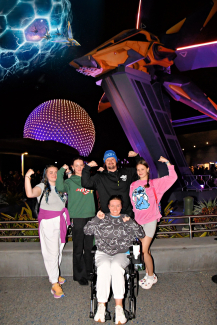
It’s been really hard in terms of noticing the changes as Anna’s MND progresses. With Anna it’s been gradual changes, and we’ve learned to evolve and adapt. But when we reflect and look back now, we realise just how much things have changed. For example, now, Anna has no mobility and is fully wheelchair bound. She has also started to lose her voice and sometimes it’s difficult to understand her. As a family, we’re all in-tune with Anna’s voice – even as it changes. We had a conversation recently and Anna asked if she should start using her communication device at home, but I told her if she doesn’t want to, she doesn’t have to. We will adapt. If that means taking more time to focus on Anna to understand what she’s saying, we’ll do that. She has banked her voice and she uses that mainly for people outside of the household. Anna has said once she starts using her communication device full time, it’s like losing the last bit of herself but I know the fact her device uses her own voice makes a big difference.
Anna’s MND has progressed meaning we don't go out much because we’re still in the process of getting a wheelchair accessible vehicle. That’s the thing with MND, when one thing ends you’re onto the next thing. We’re a generally positive family who try to make the best out of even the worst situations. Anna often says, ‘There's no place like home. We've got everything we need here.’ And she’s absolutely right. It’s always full of friends and family coming and going because it's very difficult for Anna to get into other people's houses. You become a home bird with MND and that's the evolution of it.
Adapting the home
"We were lucky enough we had a council that would listen and work with us."
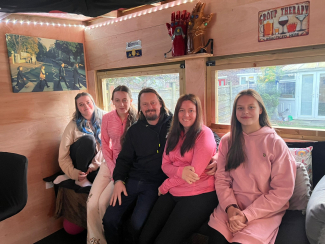
Anna uses a power chair and the house has been adapted to accommodate that. Those adaptions were massive for us. We had a bit of a battle to get the house to where we needed it – especially in terms of the Disabled Facilities Grants (DFG) and the process to get that in place. Initially, we weren't eligible for the DFG grant because Anna receives a private pension, but since we’ve both left fulltime work the impact on our finances has been massive. Anna’s pension took us over the threshold, but realistically there was no way we would have been able to cover adaptations ourselves. I stressed the importance of speed when dealing with MND and told them the reality of what MND can do and what it brings to a family. We worked with the council and our case got special consideration that went to a panel to review. The review was successful and the council awarded us the DFG which went towards all the adaptations. With the works coming to £90,000, we were able to put the difference back onto the house and we’ll pay the council back when we sell it in the future. It was the only feasible option to get the works done. Living with MND and in a no or low-income home, you’re restricted on what you can do.
We were lucky enough we had a council that would listen and work with us meaning we're in a house that is perfectly fit for Anna's needs and our family. That was one of the big things for us as well, maintaining a family home on top of the adaptations.
The council appointed a building company who were absolutely amazing. It was completely changing the whole downstairs of our home with an extension, installing a wet room, a new kitchen and widening all the doors so Anna’s chair could fit through comfortably. Before the adaptations Anna was confined to the living room for nearly a year, apart from the small distance to and from the stair lift to get upstairs to bed. Since having the adaptions, it’s been a real eye opener in the sense Anna now has so much freedom around the home. As soon as the girls walk in from school, work, or college, the first thing they see is their mum sat in the front room in her chair, rather than being upstairs in a bedroom. That was really important to us from the start. At the minute she’s sat in the living room with her eye gaze set up. She does her Amazon shopping with her eyes, sorts Christmas presents, messages friends, keeps up with social media and stays connected to what’s going on outside our four walls. She’s not shut away, she’s not isolated, she’s right there with us.
The impact of MND
"That sense of normality matters more than people realise."
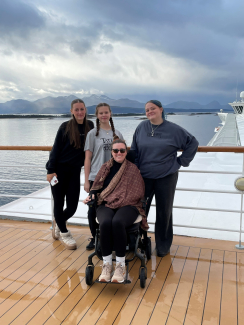
I’ve always said I don’t feel like Anna’s carer because our relationship is built on everything else we do together, not just the practical tasks. The everyday moments, the conversations, the shared experiences, they’re what keep us a family and that sense of normality matters more than people realise.
One of the first things you hear when MND comes into your life is that it takes everything except the mind. That’s true but living that reality isn’t easy. You have to actively protect your mindset. Our family saying is, 'you choose your mood.' That doesn’t mean you ignore reality or pretend it doesn’t hurt. It means you try, as much as you can, to live in the moment without being consumed by what you’ve lost. We’ve always said it’s absolutely fine to be sad. There are plenty of tears in this house. Birthdays can be hard. Christmas can be hard. But despite that, I’d say 90% of the time there’s still joy here. We know the bad days will come, but it’s about dealing with them and trying to return to the best versions of ourselves.
Advocating for the MND community
"We don’t know what’s coming, but we’ll face it when it arrives, together."
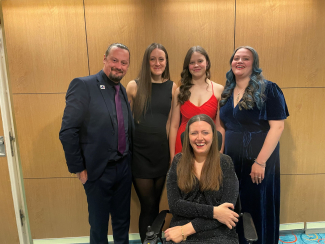
People often ask what pushes me to do the advocacy work we do. I’ve always believed that if something is wrong, complaining alone isn’t enough. You should try to change it. Everything I’ve done has been for Anna and our girls. Along the way, advocating for others has become just as important.
The reality is that alongside the fight for a cure, one of the biggest burdens families face is financial. Life is turned upside down overnight. If policies addressed those root issues, people wouldn’t be forced into crowdfunding just to live a semi-normal life. Charities wouldn’t need to step in to plug gaps that shouldn’t exist in the first place.
At the end of the day, every MND journey is different. We’re in a very different place now compared to a year ago and we’ll be somewhere else again next year. That’s the one certainty. We don’t know what’s coming, but we’ll face it when it arrives, together.