January 2026 Caregiving
Meet Rona...
Rona recounts her husband, Adrian's, journey with MND and Frontal Temporal Dementia (FTD). Rona discusses the emotional and practical challenges they faced and the lack of understanding of MND in hospitals, emphasising the importance of making every day matter. Rona's focus is on organising comedy events with her son, Anthony, to raise funds and awareness for MND research and the Association’s support services aiming to provide respite for carers and raise awareness.
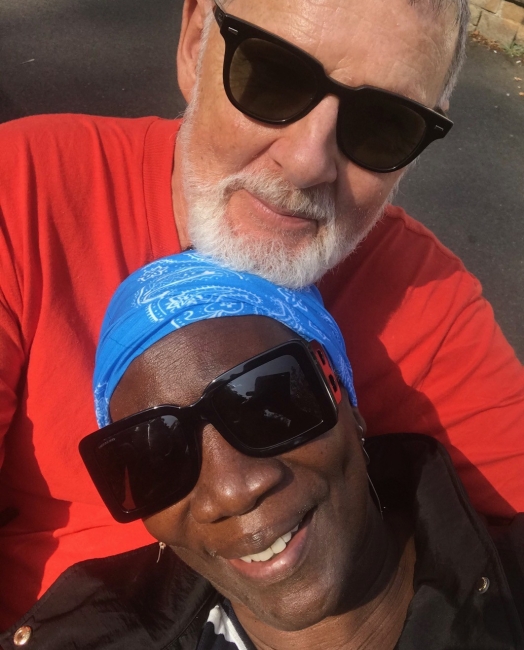
Rona shared her story with us in August 2025.
Life before MND
"At the time I didn’t connect it to anything serious."
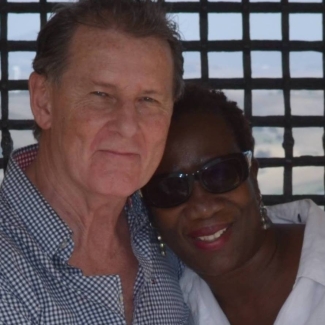
Adrian and I were together 35 years. He was active, bright and curious about everything. He was my best friend. Looking back now, I can see that it started before it really started, though at the time I couldn’t make sense of it.
We’d always been active walking a lot, but I started to notice odd pains, odd struggles. He was unsteady on his feet so I bought him walking poles, thinking they might help. We even went on a short course with a local group in Brighton to learn how to use them properly. It was simple enough, but Adrian couldn’t coordinate the movement. At the time I didn’t connect it to anything serious. I just thought maybe he needed something gentler to keep him moving, so I suggested golf or another hobby.
Early symptoms
"There were other symptoms too, when I look back at it."
Between 2018 and 2020, there were many odd moments. Adrian was precise and methodical, but now he seemed to lose interest. He’d start tasks and not finish them and that wasn’t like Adrian at all.
When we went to our place in Spain just before the first lockdown it became clearer. It was an old house in the mountains that always needed work, and normally Adrian was the one who got stuck in. But this time he couldn’t keep at it. Then he developed a terrible cough, right before we were due to fly home. Thankfully we got back to the UK but I kept thinking, ‘He’s had COVID and now he’s got long COVID.’ That explained, in my mind, the walking, the fatigue, the odd behaviour. There were other symptoms too, when I look back at it. We’d start a discussion and he’d fixate on a point, going over it again and again, unable to let it go. Sometimes he became almost fanatical about the smallest thing and I’d have to walk away. Other times, he seemed overly clingy.
Then, during a GP appointment, the doctor noticed something important. He looked at Adrian’s hand, between his thumb and index finger, and noticed the muscle was wasting away. Most GPs wouldn’t have caught it, but he did. He asked Adrian to get up on the bed and started testing his reflexes with needles. Adrian didn’t react, even when pricked in the foot. That explained the strange way he was walking. I later learned that symptom was called ‘foot drop.’
Diagnosis
"He suspected Adrian had probably had it much longer than we realised."
The GP referred Adrian to Haywards Heath hospital and that’s where the real testing began. But even then, in my mind, I kept thinking it was long COVID.
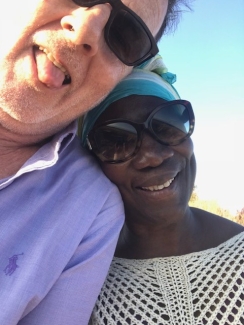
Eventually, in 2021, we got the diagnosis. Not just motor neurone disease, but also frontotemporal dementia (FTD).
It wasn’t dementia in the way people usually think. Adrian’s memory was largely intact. It was his behaviour, his personality, his emotions that were changing. The diagnosis explained so much.
We first saw Dr. Chan at Haywards Heath, and he referred us to Dr. Lee Lawson, the head of neurology. Dr. Lawson spent three hours with us, simply talking, asking questions about Adrian’s life and behaviour. By the end he had confirmed the MND diagnosis and told us he suspected Adrian had probably had it much longer than we realised.
Once the diagnosis was made, everything moved fast. Within two months we were being told hard truths. The MND team were kind but direct. It was brutal to hear, but necessary.
Adapting to MND
"Moving gave us freedom. It meant we could live, not just cope."
At the time we were living in a beautiful Grade I listed building in Brighton on the ground floor. But when the occupational therapist came to assess it, she was very clear the building wasn’t appropriate or adaptable to the progression of Adrian’s MND. He would need a wheelchair, a specialist recliner chair and none of it could be delivered or used properly in that flat. Even the ambulance crew wouldn’t have been able to get him out easily.
I knew then we had to move, so I started searching online and I found a development described as ‘future-proof living.’ It was perfect. Wide doors ready for wheelchairs, a large wet room, toilets already at the right height. Everything was built to be accessible.
We reserved one of the apartments while it was still being built, though of course there were delays so we didn’t move in until May 2022. By then, Adrian was using two walking sticks. Moving gave us freedom. The space was right, the adaptations ready. It meant we could live, not just cope.
The impact of MND
"That was him, alive, noisy, impossible to miss. You’d never know how ill he really was."
We had so many plans. We were going to travel to Jamaica and renew our vows. We wanted to return to Santorini. We dreamed of driving through Italy and Switzerland. Some of those trips we’d even booked. But in the end, I had to cancel them all.
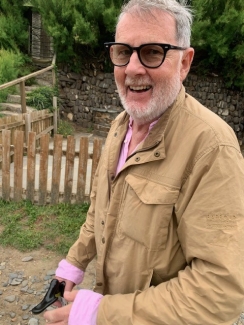
Caring was physically and emotionally hard. Adrian could be difficult at times, convinced he could do more than he really could. I had to cajole him, persuade him otherwise, balance his independence with safety. That constant negotiation was exhausting.
Adrian’s lack of filter could be mortifying at times, but also funny. He’d blurt things out and I’d want the ground to swallow me. But later I could laugh. Even the consultants often laughed with him. That was him, alive, noisy, impossible to miss. You’d never know how ill he really was.
Support group meetings
"It was such kind, practical advice."
Very early on a lovely lady called Elsa reached out to me. I’d met her at one of the MND support meetings. I didn’t take to those groups very well. Elsa must have seen how uncomfortable I was. She came to me and talked about things like the feeding tube and reassured me and reminded me to enjoy each moment with him. I asked her for advice about what to do when I get cross and she told me, ‘Just be cross with him. Be normal.’ It was such kind, practical advice from someone who had been there herself, although Elsa’s husband had MND for 18 months after his diagnosis whereas I had nearly three and a half years with Adrian. It may sound like a long time to some, but to me it was no time at all.
Elsa became a real friend and reassured me all the thoughts and feelings I had were normal. That comforted me more than I can say.
Caring support
"I hadn’t realised how much heavy lifting I was doing until I had support."
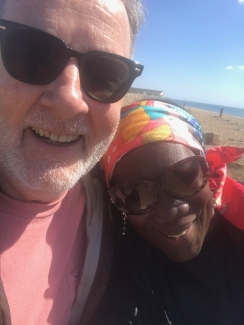
Care was harder for me to accept. The move had been easy in practical terms because of the design of the flat, but once Adrian started needing help with personal care, it was different. I managed on my own for quite a while. I dressed him, managed meals. It was tiring, but I was happy to do it. The thought of strangers coming in felt like an invasion, a loss of dignity for him and for us.
But then he was admitted to hospital with pneumonia which is common in MND. They assessed him and insisted on a six-week care package once he came home. Adrian was tall - six foot two - and although very slim he was still solid. Because of his size and weight the carers insisted two people were needed for transfers. At first I resisted, but in the end it was actually a relief. I hadn’t realised how much heavy lifting I was doing until I had support.
Morning and evening carers came in. At first, I found that very difficult. I’d been used to looking after him myself, in my own way, in my own time. Suddenly I had strangers in the house, moving around our space, taking over routines I had built. It felt like a loss of control and I had to make sure they worked the way I wanted, in a way that preserved Adrian’s dignity. Eventually, once they understood how I wanted things to run, it worked well.
Lack of understanding in the NHS
"What’s needed in hospitals is specialist understanding like what Omaze is helping to fund."
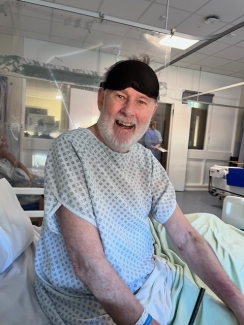
With MND you’re dealing not just with the disease itself but also with all the other health problems that come with a weakened body. Each hospital visit brought new challenges. When I explained Adrian had FTD, doctors and nurses often assumed it meant dementia. But Adrian wasn’t oblivious. He might be confused at times but he understood what was happening.
What’s needed in hospitals is specialist understanding like what Omaze is helping to fund.
What I kept running up against was the lack of understanding in general hospital wards. I was told more than once I could only visit Adrian during visiting hours and I would argue I only wanted to sit by his bedside. He was vulnerable and I knew I had to fight for him.
He spent seven days in that hospital. Before he was transferred from A&E to the ward, one of the registrars turned to me and said, ‘If I ever get MND, I hope I have a partner like you. You fight battles, but you do it in such a kind way.’ That stayed with me. Because you do have to battle, constantly. You have to be patient, calm, endlessly diplomatic, even when all you want to do is scream.
Fundraising for MND
"I think laughter is a perfect vehicle for fundraising."
For two years running, I did the 15,000 steps-a-day challenge for 31 days in January. Starting on New Year’s Day, after celebrating the night before, I’d be out walking every day without fail. I was determined.
I remember when Kevin Sinfield came to Brighton during one of his runs. Adrian was too unwell to come, but I went with my son Anthony. Kevin was so motivating, so passionate. Afterwards, Anthony said to me, ‘Mum, we could do comedy for MND.’ And that’s how Comedy vs MND began.
Seeing this idea take shape with my son by my side has been incredible. It’s a testament to Adrian’s spirit and the love that continues to ripple outward. The irony of it all was that despite everything, Adrian remained so cheerful. Laughter was his constant companion throughout his illness, leaving a lasting impression on everyone around him.
Comedy has given me something to focus on now. I think laughter is a perfect vehicle for fundraising. The goal is simple: sell tickets and raise money for MND. The work has been exciting, but it’s also triggering at times.
Advice to others
"I would do it all again in a heartbeat for him."
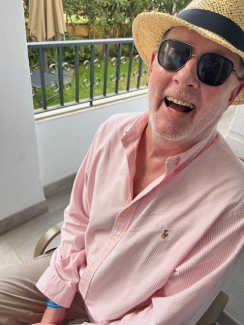
If I could offer advice, it would be to take every day as if it’s your last. Don’t plan endlessly. Do what you can, while you can. For us we found joy in food, in eating at the best restaurants. Adrian adored desserts and chocolate. Food became part of our love story. Whatever your passion is, big or
small, do it. Every day you can. And never forget to tell the person you love that you love them. Say it, show it, mean it. Because if there’s one thing I know for sure, it’s this: I would do it all again in a heartbeat for him.
My memory of Adrian isn’t of him in the wheelchair. It isn’t the final months. What remains is before… the joy, the humour, the closeness. We had a near-perfect life together.