January 2026 Fundraising
Meet Martin...
Martin shares his journey from a small town in Newcastle to a globetrotting career teaching in Africa and now running his own escape rooms back in his hometown. Diagnosed with MND in 2023, Martin emphasises the importance of support from family and friends. When we spoke to Martin, he was preparing for an epic fundraiser cycling from coast-to-coast with a group of family and friends to raise money and awareness for MND.
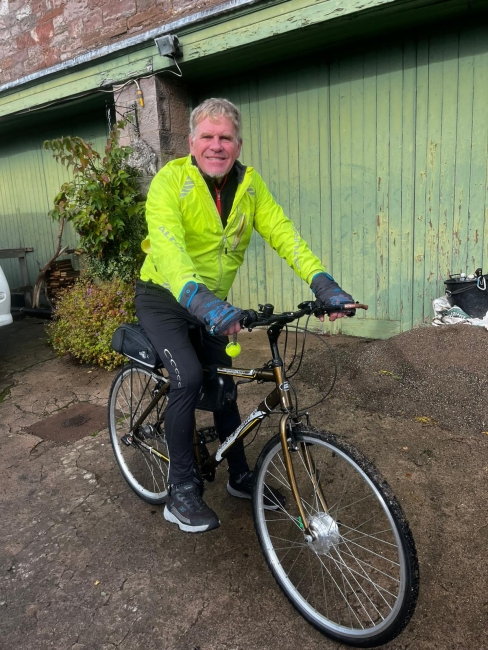
Martin shared his story with us in September 2025.
Life before MND
"I wanted it to be the best escape room experience possible."
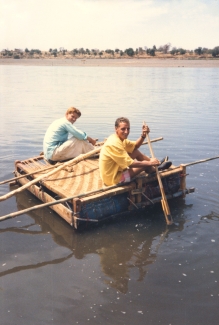
My name’s Martin and I live in Newcastle. I’m originally from Ashington but I left years ago to travel the world and have lived in places like Turkey, Sudan and Nigeria. After my time in Sudan I came back, met my wife Rachel and then went to teach in Turkey for about a year. When I returned I qualified as a teacher and taught in a primary school for a couple of years. Then Rachel and I went to Nigeria to teach.
When our second child was born we were living in a one-bedroom flat. We agreed we’d outgrown our London life and decided to make the move back up north. It turned out to be one of the best decision we’ve ever made. Now we live in a lovely part of Newcastle surrounded by friends. We have three children, Nathan, Jake and Martha.
When we relocated I ended up getting a job in Ashington of all places. I carried on teaching in primary schools and then applied for a role with Newcastle United Football Club through a government scheme called Playing for Success. It used the power of sport to motivate pupils who were struggling at school. When my role at the club ended I set up my own business running workshops and school holiday camps with activities like crime scene investigations, robot wars and a ‘Spy School’ where kids would crawl through laser mazes, find USB sticks and track down enemy agents. After a conversation with my brother, Michael, I decided to set up my own escape room with his help.
I wanted it to be the best escape room experience possible, something really special. We didn’t cut corners. That’s been my focus since 2017. Now because of MND, there’s a lot I can’t physically do anymore, like the building and hands-on stuff that I used to love. So I’m handing things over to my son Jake, supporting him and trying to pass on what I’ve learned along the way.
Early symptoms and diagnosis
"I think I was half-expecting the diagnosis."
About a year and a half before my diagnosis I started to notice a slight weakness in my right-hand grip. Then I began to see a strange rippling in the muscles of my upper arm. I now know are called fasciculations. It looked odd, like the muscles were moving under the skin.
I went to the doctor and mentioned it, but they didn’t seem particularly concerned and suggested I wear a splint on my hand. I kept going back, saying something wasn’t right but they thought maybe it was carpal tunnel syndrome. It took quite a bit of persistence before they finally agreed to refer me to a specialist and even then the referral was going to take nine months. Nine months felt like a lifetime, so I decided to go private. He referred me to
a neurologist straightaway and I was seen within two weeks. I know not everyone can afford that, but for me, it saved months of worry and uncertainty.
I had an MRI and nerve conductivity tests. You could see the muscles quivering on the screen as they put the needles in. It was strange, but what stuck with me most was the two-week wait for results afterwards. When we finally went for the results, I think I was half-expecting the diagnosis.
In December 2023 I was diagnosed with motor neurone disease. They talked through what monitoring and support would look like and then Rachel and I walked home from the hospital and we both just broke down at exactly the same time. It was like the reality hit us both together.
At the time, I was still running my own business – the escape rooms – seven days a week. Staying busy helped stop me overthinking it. But even so, your mind always drifts back to it. It’s hard to fully switch off from it.
Telling family and friends
"I’d rather someone talk about it than avoid it altogether."
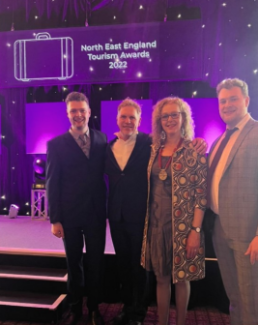
Nathan’s wedding happened after the tests but before the diagnosis and I didn’t tell him anything at the time because I didn’t want to overshadow his day. When the results came through he and his wife were in Bahrain and I told them over the phone. I could hear from their reaction that it was a shock.
Our other two were very upset too. At first they didn’t really want to show it. I think that’s natural, they didn’t want to make things harder for me. But now I make a point of asking how they’re doing with it. Even when we’re just watching football in the pub, I’ll check in with them.
Martha, our daughter at university in Glasgow, took it quite hard. She told Rachel that it really hits her each time she comes home because she sees the changes all at once. The MND Association kindly gave her a grant so she can come back and see us more often, they have also helped with referring her for counselling.
When I turned 60 I had a big party and decided to tell everyone there. I tried to make it a bit humorous, it was my way of lightening the load. People cope in different ways. Some don’t know what to say, so they say nothing. Personally, I’d rather someone talk about it than avoid it altogether.
If anything, this has brought our family closer together. It’s made us all a bit more open, more likely to say how we really feel. It’s been tough on everyone but we’re getting through it together.
The impact of MND
"You fight for every bit of independence you can keep."
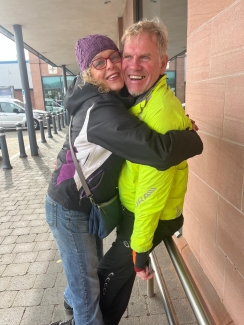
At first I could still walk fine, I could climb stairs and use tools. But over time my legs have weakened. I can still walk but it doesn’t feel natural anymore, it’s like my legs belong to someone else. You realise just how many muscles are involved in keeping your balance and some of mine just aren’t doing their job anymore. I can walk maybe a hundred metres before it becomes an effort.
My arm muscles have begun to waste and my right-hand grip has gotten weaker. Now, my hands are almost frozen. I can’t move my fingers at all. It’s spread slowly from one hand to the other. Small everyday tasks take huge amounts of time and energy. Opening a packet, squeezing toothpaste, putting on socks can take half an hour alone. Getting dressed is hard, especially jumpers because my bent hands get caught in the sleeves. Even picking up a towel from the floor can be a real struggle.
You don’t always want to ask for help so you fight for every bit of independence you can keep. It’s a challenge, but one worth fighting for.
It’s made me appreciate my friends and family even more and helped me reflect on what I enjoy. I like drinking, so I drink. I like watching sport, so I do that. I like cycling, and I love watching films, especially when my daughter’s sitting next to me, sharing Maltesers, drinking red wine, chatting about the story. Those little things mean the most.
Association support
"Research for a cure matters, but so does helping people who are living with MND today."
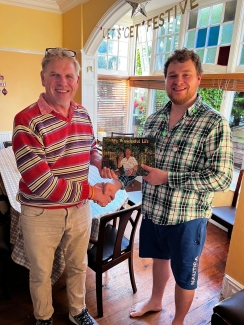
The MND Association have been brilliant. We applied for grants and were given some funding to go on holiday, which helped cover the extra insurance costs and also for general living expenses and quality-of-life improvements. That kind of support makes such a difference. It’s not just about research, it’s about helping people to live well right now. Research for a cure matters, but so does helping people who are living with MND today. Helping them create memories, live comfortably and find moments of joy while they still can.
The support groups have been brilliant. I was saying how my hands get really cold and someone who I was talking to showed me his heated gloves and sent me the link to get some. It’s those little exchanges, that peer support, that really helps.
You hear people call them ‘support groups’ and maybe that sounds heavy, but in reality it’s just people sharing experiences, giving each other advice and sometimes having a laugh. The staff are kind, compassionate and they keep us updated on fundraising and events. They make you feel seen and valued, never pitied.
Adapting to MND
"We’ve self-funded every adaptation."
We saw the occupational therapist about a month after my diagnosis. She talked us through what I’d likely need in the future. Things like a stair lift,
adaptations to the home, daily equipment and aids. Because we had some savings we didn’t qualify for any financial help from the council. So we funded everything ourselves. We’ve not gone as far as installing a lift yet, but we’ve changed the whole layout downstairs. There’s now a wet room and one of those wash-and-dry toilets, we had the kitchen floor raised so everything’s level for when I need to use a chair around the home. When all the work was being done, I couldn’t really picture a time when I wouldn’t be able to walk. But lately, I’m starting to realise that day might come.
We also put decking at the front of the house, so the entrance is level. It actually looks really nice, but again, there was no support available from the council, so we’ve self-funded every adaptation. We love our house. We’ve lived here a long time, and it’s full of memories. So even though all the adaptations cost a fortune, it was worth doing. We didn’t want to move.
The big fundraiser
"Even with MND you can still find ways to do the things you love."
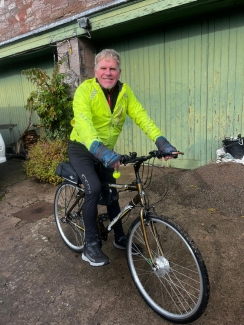
My friend Richard and his wife Sasha volunteer for a local charity called Recyke y’Bike in Newcastle and they started adapting a bike for me. The first change was to help me brake, now I can brake by pedalling backwards. They also replaced the twist-grip gears with a big lever so I can just push forward or back to change gear. My friend Tony fitted a front-wheel motor with an electric battery pack so if there’s a hill coming up, I can just turn on the assistance.
All those adaptations mean I can still get out on the bike and that’s huge. It keeps me moving, keeps me connected to the world and reminds me that even with MND you can still find ways to do the things you love.
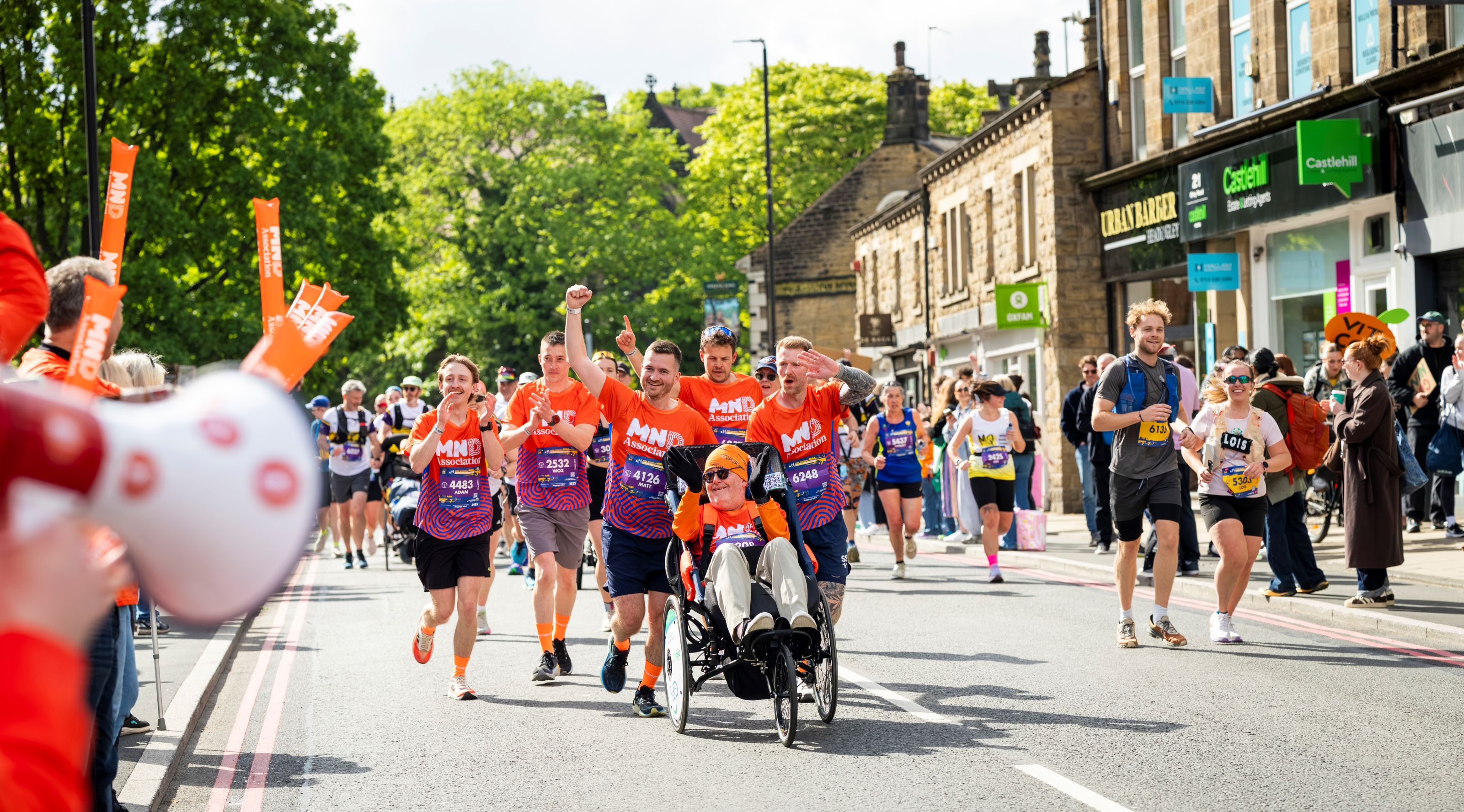
We’ve been out on a few rides now as a group of friends and I mentioned I’d done the coast-to-coast route years ago with my sons and one of us suggested we do it. Gradually more people joined in, friends, family and others who just wanted to be part of it. I said I’d try to raise some money for the MND Association while we were at it. Now it’s become a proper event. We’ve got MND Association T-shirts, wristbands and a collection bucket.
It’ll be a genuine challenge because cycling is getting harder for me, but we’re constantly adapting the bike to help me keep going.
Advice to others
"You can still have a full, meaningful life with your friends and family."
There’s so much information out there, especially online and not all of it is good. But there is a lot of practical advice out there, particularly from the MND Association website.
The support is there. You’ll have dietitians who’ll advise on what to eat, what to avoid if swallowing becomes difficult. Physiotherapists who’ll give you exercises to keep your muscles active. Psychologists and counsellors who’ll talk through how you’re coping mentally. You get this whole network of people around you. They can’t cure you, but they can make the journey easier.
The diagnosis is devastating, but it’s not the end of your life. You can still have a full, meaningful life with your friends and family. It brings people closer together. And strangely, it’s been a wake-up call for some of my friends too. They’ve realised that something could happen to any of us, at any time. It’s made them want to do more, to live better.
So my advice would be keep doing what you can do. Don’t be afraid to ask for help when you need it, but don’t give up too early either. There’s still plenty you can do.
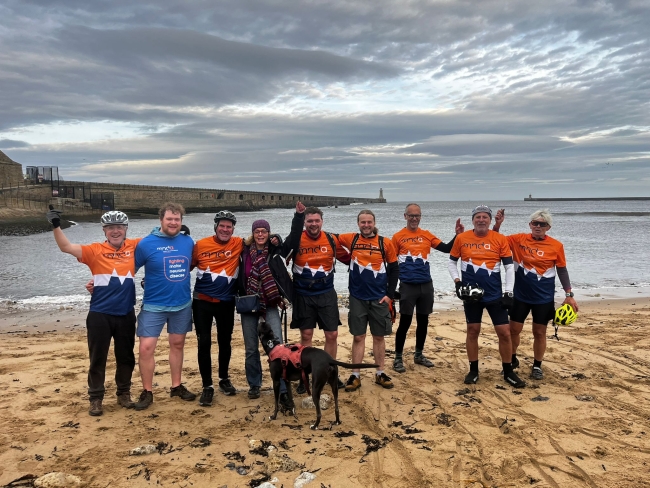
On 3 October, Martin and a group of family and friends set off on their coast-to-coast fundraiser. Here, Martin reflects on the challenge.
Post-fundraiser reflections
The fundraiser event went better than I ever imagined. It was a very eventful experience and one I don’t think any of us will forget.
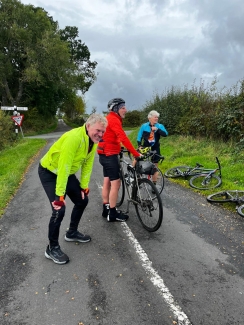
Setting off from Whitehaven on Friday morning as storm Amy hit land meant we battled through 80mph gusts of wind and horizontal sleet. I was soaking wet and freezing cold which seemed to affect the movement and strength in my arms and legs. While we were riding the donations kept coming and this really helped push us on knowing people – including complete strangers – were supporting us.
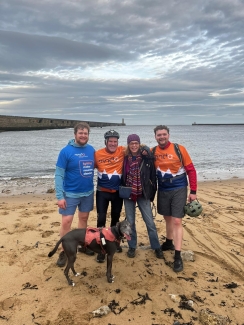
The following day the storm eased, and we made good progress. Hills were a particular challenge, and I made use of the portable ventilator provided by the Home Ventilation team at the Royal Victoria Infirmary hospital in Newcastle. On the final day the weather was better, but my arms and legs felt pretty fatigued and there were a few falls. We arrived at Tynemouth just after 5.00pm on Sunday to a whooping welcome party of friends and family and finished with the tradition of dipping our front wheels in the North Sea.
The Association and local branch have really supported me and my family in lots of ways and I’m happy the money will help them continue to support people and their families in the north east who are affected by MND.